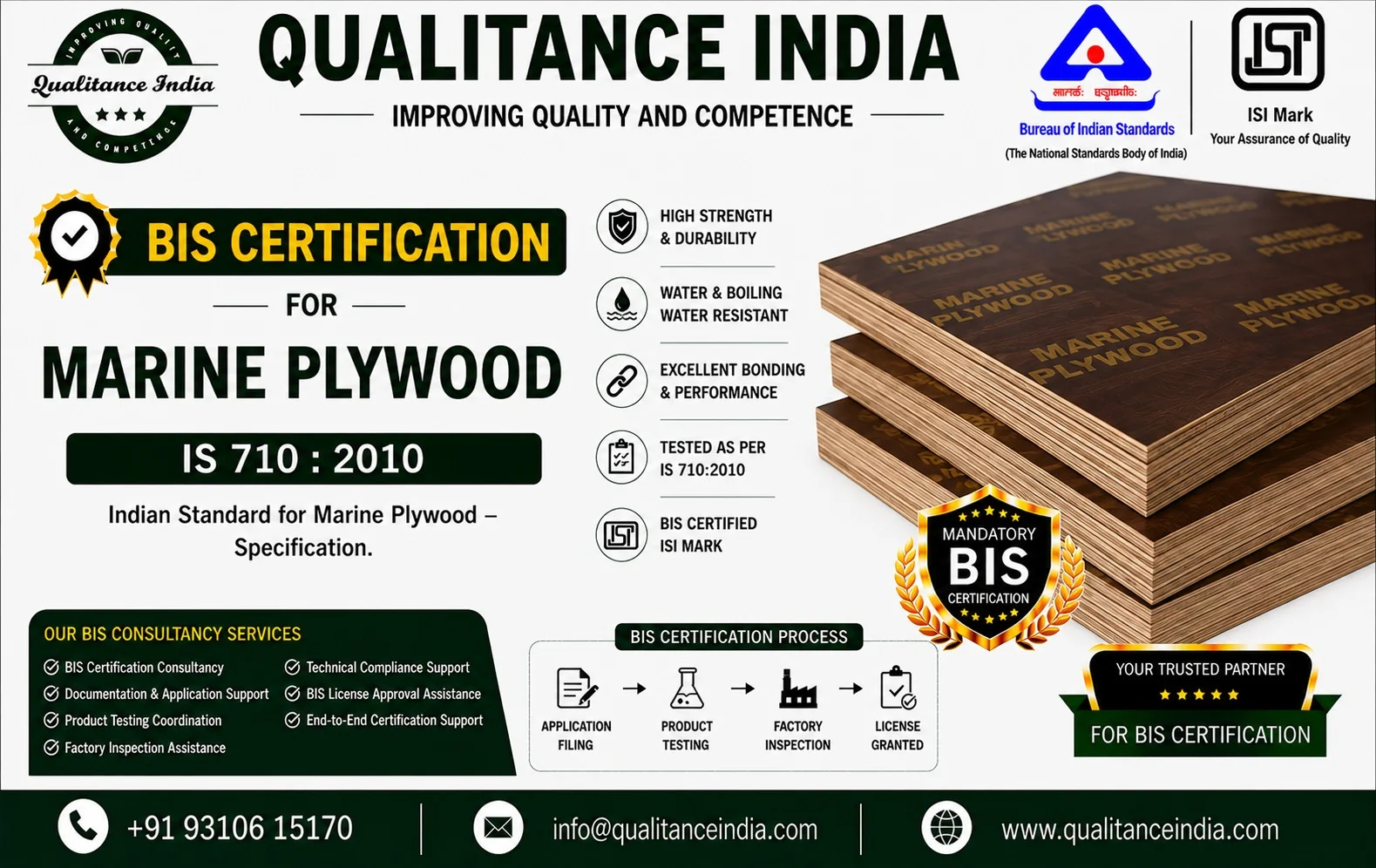
BIS Certification Consultancy for Marine Plywood | IS 710:2010
Introduction
Marine Plywood is a high-quality plywood product designed for applications where plywood may be exposed to moisture, humidity and demanding service conditions. It is commonly used in construction, furniture, interior applications, transportation and other areas where improved moisture resistance and durability are required.
For manufacturers of Marine Plywood in India, compliance with the applicable Indian Standard is important for maintaining consistent product quality and meeting applicable BIS requirements.
IS 710:2010 – Marine Plywood – Specification specifies requirements for marine plywood, including requirements relating to materials, construction, dimensions, workmanship and performance.
Qualitance India provides BIS Certification Consultancy for Marine Plywood as per IS 710:2010, supporting manufacturers with product assessment, documentation, testing, BIS application and factory inspection preparation.
Product ke baare mein
Marine Plywood is manufactured by bonding multiple layers or veneers of wood together using suitable adhesive under controlled pressure and temperature.
The cross-laminated construction of plywood provides:
- Good dimensional stability
- Strength
- Durability
- Resistance to moisture-related deterioration
- Better performance compared with ordinary plywood in demanding conditions
Marine Plywood can be used in applications such as:
- Furniture
- Doors
- Construction
- Interior work
- Kitchen applications
- Transportation
- Ship and boat-related applications
- Moisture-prone areas
- Industrial applications
The final quality of plywood depends on the quality of timber, veneer preparation, adhesive, pressing conditions, panel construction and finishing.
Applicable IS Standard
The applicable Indian Standard is:
IS 710:2010 – Marine Plywood – Specification
The standard specifies requirements for Marine Plywood and covers applicable requirements related to its manufacture and quality.
Manufacturers should verify the latest edition, amendments and current BIS requirements before beginning the certification process.
Scope of Standard
IS 710:2010 covers Marine Plywood intended for applications requiring plywood with suitable durability and resistance to moisture-related conditions.
The standard specifies requirements relating to characteristics such as:
- Timber and veneers
- Adhesive
- Construction
- Dimensions
- Thickness
- Moisture content
- Bonding quality
- Strength
- Workmanship
- Surface condition
- Defects
- Marking
The exact requirements should be evaluated according to the applicable provisions of IS 710:2010.
Product Requirements
Marine Plywood should comply with the applicable requirements specified in IS 710:2010.
Veneer Quality
The veneers used for manufacturing plywood should meet the applicable requirements regarding quality and suitability.
Panel Construction
The veneers should be properly arranged and bonded to form a stable plywood panel.
Adhesive
The adhesive system should be suitable for manufacturing plywood intended for the specified service conditions.
Thickness
The finished plywood should comply with the specified thickness and applicable tolerances.
Dimensions
Panel length, width and thickness should meet the applicable requirements.
Bonding Quality
The bonding between veneers is an important characteristic of Marine Plywood.
Strength
The plywood should meet applicable mechanical-performance requirements.
Moisture Content
Moisture content should remain within the specified limits.
Workmanship
Finished panels should be properly manufactured and should not contain unacceptable defects.
Testing Requirements
Testing is an important part of BIS Certification for Marine Plywood.
Depending on the applicable requirements, testing may cover:
- Dimensions
- Thickness
- Moisture content
- Glue adhesion or bonding quality
- Water resistance
- Bending strength
- Modulus of elasticity
- Other applicable mechanical properties
- Workmanship
- Surface condition
Testing should be conducted using the applicable test methods specified in IS 710:2010 and its referenced standards.
Bonding and Water Resistance Testing
One of the important characteristics of Marine Plywood is the quality of bonding between the veneers.
Testing helps determine whether the adhesive bond can withstand the conditions specified for the product.
Depending on the applicable requirements, testing may evaluate:
- Adhesion between veneers
- Bond durability
- Resistance to water exposure
- Delamination
- Glue-line performance
Good adhesive selection and proper pressing conditions are important for achieving consistent bonding quality.
Mechanical Testing
Mechanical properties are important because plywood panels need to withstand handling and service loads.
Applicable tests may include:
- Bending strength
- Modulus of elasticity
- Other specified strength characteristics
The test results should meet the requirements applicable to the relevant plywood type and thickness.
Raw Material Requirements
The principal raw material used for manufacturing Marine Plywood is timber.
Other important materials may include:
- Timber logs
- Veneers
- Adhesives
- Resin systems
- Preservative or treatment materials, where applicable
- Finishing materials
Manufacturers should maintain proper control over raw materials.
Important records may include:
- Supplier details
- Timber specifications
- Veneer details
- Adhesive specifications
- Batch numbers
- Raw-material test reports
- Incoming inspection records
- Storage records
- Material traceability
Manufacturing Requirements
A typical Marine Plywood manufacturing process may involve:
- Timber procurement
- Log inspection
- Log storage
- Peeling or slicing
- Veneer preparation
- Veneer drying
- Veneer grading
- Adhesive preparation
- Glue application
- Veneer assembly
- Pre-pressing
- Hot pressing
- Conditioning
- Trimming
- Sanding
- Dimension inspection
- Quality testing
- Surface inspection
- Sorting
- Packing
- Marking
- Final dispatch
The actual manufacturing process may vary depending on the manufacturer's machinery and production technology.
BIS Certification Process
Step 1 – Product Assessment
The Marine Plywood product is evaluated against the applicable requirements of IS 710:2010.
Step 2 – Product Scope Identification
The applicable plywood types, thicknesses and product varieties are identified.
Step 3 – Factory Assessment
The manufacturing process, machinery and quality-control arrangements are reviewed.
Step 4 – Testing Facility Review
Applicable testing facilities and equipment are assessed.
Step 5 – Documentation
Required technical and factory documents are prepared.
Step 6 – Sample Preparation
Representative plywood samples are selected according to applicable requirements.
Step 7 – Laboratory Testing
Samples are tested for applicable physical and mechanical characteristics.
Step 8 – BIS Application
The required BIS application and supporting documents are submitted.
Step 9 – Application Scrutiny
BIS reviews the application and submitted documents.
Step 10 – Factory Inspection
The manufacturing facility may be inspected to verify production and quality-control capabilities.
Step 11 – Observation Closure
Any observations or deficiencies are addressed.
Step 12 – Licence Grant
After successful completion of applicable requirements, the BIS licence is granted for the approved product scope.
Documents Required
Typical documents may include:
- Company registration documents
- Factory address proof
- Factory layout
- Manufacturing process flow
- Machinery list
- Product specifications
- Plywood drawings
- Thickness details
- Timber/raw-material details
- Veneer specifications
- Adhesive details
- Raw-material test reports
- Internal test reports
- Laboratory test reports
- Testing equipment list
- Calibration certificates
- Quality-control plan
- Inspection records
- Production records
- Product photographs
- Packing details
- Marking details
- Authorised signatory documents
- Trademark documents, where applicable
The exact document requirements depend on the manufacturer and proposed certification scope.
Factory Inspection
Factory inspection helps verify whether the manufacturer has adequate facilities to consistently produce conforming Marine Plywood.
The inspection may cover:
Timber Storage
Timber and other raw materials should be properly identified and stored.
Veneer Production
Peeling, slicing, drying and grading facilities may be inspected.
Adhesive Preparation
The adhesive preparation and application system may be assessed.
Assembly
Veneer arrangement and panel assembly procedures may be checked.
Pressing
Pressing equipment and process parameters may be reviewed.
Finishing
Trimming, sanding and finishing arrangements may be inspected.
Testing Facilities
Suitable equipment should be available for applicable quality checks.
Calibration
Testing and measuring instruments should have appropriate calibration or verification records.
Quality Control
Incoming, in-process and final product inspection systems should be maintained.
Records
Production, testing, inspection and calibration records should be properly maintained.
Product Quality Checks
Manufacturers should conduct quality checks at different stages of production.
These may include:
- Timber inspection
- Veneer thickness
- Veneer quality
- Moisture content
- Adhesive inspection
- Glue application
- Panel construction
- Pressing conditions
- Panel thickness
- Panel dimensions
- Bonding quality
- Water resistance
- Bending strength
- Modulus of elasticity
- Surface quality
- Defect inspection
- Workmanship
- Final product inspection
- Packing inspection
- Marking verification
Common Reasons for Testing/Certification Failure
Common reasons for non-conformity may include:
- Poor-quality timber
- Improper veneer preparation
- Incorrect veneer thickness
- Excessive moisture content
- Incorrect adhesive formulation
- Poor glue application
- Insufficient bonding
- Delamination
- Improper pressing conditions
- Thickness variation
- Dimensional variation
- Low bending strength
- Unsatisfactory mechanical properties
- Surface defects
- Poor workmanship
- Inadequate testing facilities
- Missing calibration records
- Incorrect sampling
- Incomplete documentation
- Incorrect product specifications
- Improper marking
Pre-testing and effective process control can help reduce avoidable failures.
BIS Marking
After certification, the manufacturer must follow the applicable BIS marking requirements and conditions of the BIS licence.
Applicable marking may include:
- BIS Standard Mark
- Licence number
- Manufacturer identification
- Product identification
- Grade or type
- Thickness
- Batch or lot details
- Other required information
The exact marking format should be followed according to the current BIS certification conditions.
Who Needs BIS Certification
Manufacturers producing Marine Plywood should assess the current BIS and regulatory requirements applicable to their products.
This may include:
- Plywood manufacturers
- Timber-product manufacturers
- Marine plywood manufacturers
- Building-material manufacturers
- Furniture material suppliers
- Construction-material suppliers
- Interior-material manufacturers
- Plywood exporters/importers
- Institutional suppliers
Where BIS certification is mandatory under the applicable regulatory framework, manufacturers must comply with the relevant requirements before supplying the product.
Cost
The total cost of BIS Certification depends on several factors, including:
- BIS application charges
- Laboratory testing charges
- Number of product varieties
- Thickness range
- Sample requirements
- Factory inspection
- Testing equipment
- Calibration
- Retesting, if required
- Consultancy charges
The actual cost can be estimated after reviewing the manufacturer's product range, factory facilities and proposed certification scope.
Timeline
The certification timeline depends on:
- Product readiness
- Documentation
- Sample preparation
- Laboratory availability
- Testing
- BIS application scrutiny
- Factory inspection
- Closure of observations
Complete documentation and proper testing arrangements can help reduce unnecessary delays.
Benefits of BIS Certification
Consistent Product Quality
Testing and quality-control procedures help maintain consistent Marine Plywood quality.
Better Durability
Proper manufacturing and bonding controls can improve the durability of plywood.
Customer Confidence
Compliance with applicable standards can increase confidence among customers and institutional buyers.
Market Acceptance
Meeting applicable Indian Standard requirements can support market acceptance.
Better Manufacturing Control
The certification process encourages systematic production, testing and inspection.
Business Credibility
Compliance with relevant standards can strengthen the manufacturer's credibility in the plywood and building-material sector.
Why Choose Qualitance India
Qualitance India provides BIS Certification Consultancy for plywood, timber, building materials, furniture materials and industrial products.
For Marine Plywood as per IS 710:2010, our consultancy support can include:
- Product applicability assessment
- IS 710:2010 requirement review
- Product scope assessment
- Documentation assistance
- Testing requirement identification
- Laboratory testing coordination
- Sample preparation guidance
- BIS application assistance
- Factory inspection preparation
- Testing equipment guidance
- Quality-control documentation
- Observation closure support
- Certification assistance
We help manufacturers organise the certification process from initial product assessment through testing and factory inspection.
Complete Process
Product Identification
↓
IS 710:2010 Requirement Review
↓
Plywood Type & Thickness Assessment
↓
Raw Material & Adhesive Review
↓
Manufacturing Facility Assessment
↓
Testing Facility Review
↓
Documentation Preparation
↓
Sample Preparation
↓
Laboratory Testing
↓
BIS Application
↓
Application Scrutiny
↓
Factory Inspection
↓
Observation Closure
↓
BIS Licence / Certification
↓
Applicable BIS Marking
20 FAQs
1. What is Marine Plywood?
Marine Plywood is a plywood product manufactured for applications requiring improved durability and resistance to moisture-related conditions.
2. What is IS 710:2010?
IS 710:2010 is the Indian Standard for Marine Plywood – Specification.
3. Where is Marine Plywood used?
It can be used in construction, furniture, interior work, transportation and applications where durable plywood is required.
4. What raw material is used for Marine Plywood?
Timber veneers are the primary material used, together with suitable adhesive systems.
5. Why is adhesive important in Marine Plywood?
Adhesive provides bonding between veneers and is critical to the panel's structural integrity and resistance to delamination.
6. Is moisture content tested?
Yes, moisture content is an important quality parameter where specified by the applicable standard.
7. Is bonding quality tested?
Yes. Bonding between veneers is an important performance characteristic.
8. Is water resistance important?
Yes. Marine Plywood is intended for demanding applications where resistance to moisture-related conditions is important.
9. Is bending strength tested?
Applicable mechanical-strength requirements may include bending strength.
10. Is thickness checked?
Yes. Finished plywood should comply with applicable thickness requirements and tolerances.
11. Is factory inspection required?
Factory assessment may form part of the applicable BIS certification process.
12. What documents are required?
Factory documents, product specifications, manufacturing details, raw-material information, testing records and quality-control documents may be required.
13. Are testing facilities required?
Suitable testing arrangements should be available for the applicable product requirements.
14. What can cause Marine Plywood testing failure?
Poor bonding, delamination, incorrect moisture content, dimensional variation, low strength and poor workmanship can result in non-conformity.
15. Can different thicknesses be covered?
The applicable certification scope and product-grouping requirements determine which thicknesses can be covered.
16. How much does BIS Certification cost?
The cost depends on product scope, laboratory testing, factory inspection and other applicable expenses.
17. How long does BIS Certification take?
The timeline depends on documentation, testing, application processing, factory inspection and closure of observations.
18. Can Qualitance India assist with laboratory testing?
Yes. Qualitance India can assist with laboratory-testing coordination and related certification requirements.
19. Can Qualitance India help with the BIS application?
Yes. Consultancy support can include documentation preparation and BIS application assistance.
20. Why should Marine Plywood manufacturers follow IS 710:2010?
Following the applicable standard helps manufacturers maintain consistent quality and performance of Marine Plywood.
People Also Ask
What is the BIS standard for Marine Plywood?
The applicable Indian Standard is IS 710:2010.
What is Marine Plywood used for?
Marine Plywood is used in construction, furniture, interior, transportation and other applications requiring durable plywood with suitable resistance to moisture-related conditions.
What tests are performed on Marine Plywood?
Depending on the applicable requirements, testing may cover dimensions, moisture content, bonding quality, water resistance and mechanical properties.
Is BIS Certification mandatory for Marine Plywood?
Manufacturers should verify the current BIS and regulatory requirements applicable to their particular product and intended market.
What documents are required for Marine Plywood certification?
Product specifications, factory documents, manufacturing details, raw-material information, testing records and quality-control documents may be required.
How can I obtain BIS Certification for Marine Plywood?
The process generally involves product assessment, documentation, sample testing, BIS application, factory inspection and completion of applicable requirements.
Related BIS Certification Services
- BIS Certification for Plywood
- BIS Certification for Commercial Plywood
- BIS Certification for Structural Plywood
- BIS Certification for Decorative Plywood
- BIS Certification for Flush Doors
- BIS Certification for Block Boards
- BIS Certification for Fibre Boards
- BIS Certification for Wooden Products
- ISI Mark Certification
- BIS Testing Assistance
- BIS Factory Inspection Assistance
Related Topics
- Marine Plywood IS 710:2010
- BIS Certification for Marine Plywood
- Marine Plywood Testing
- IS 710:2010 Requirements
- Marine Plywood Quality Standards
- Plywood Bonding Testing
- Plywood Moisture Testing
- Plywood Mechanical Testing
- BIS Certification for Plywood Manufacturers
- BIS Consultancy for Plywood Industry
Contact Qualitance India
Phone: +91 93106 15170
Email: info@qualitanceindia.com
Website: qualitanceindia.com
For assistance with BIS Certification Consultancy for Marine Plywood as per IS 710:2010, contact Qualitance India for product assessment, documentation, laboratory testing coordination, BIS application and factory inspection support.
Conclusion
Marine Plywood is an important wood-based panel product used in applications where strength, durability and resistance to moisture-related conditions are required.
IS 710:2010 – Marine Plywood – Specification provides applicable requirements for the quality and performance of Marine Plywood. Manufacturers should maintain proper control over timber, veneers, adhesive, panel construction, pressing, dimensions, bonding and final product testing.
The certification process can involve product assessment, documentation, sample preparation, laboratory testing, BIS application, factory inspection and completion of applicable requirements.
Qualitance India provides BIS Certification Consultancy for Marine Plywood as per IS 710:2010, helping manufacturers with product assessment, documentation, testing coordination, BIS application and factory inspection preparation.
Phone: +91 93106 15170
Email: info@qualitanceindia.com
Website: qualitanceindia.com