
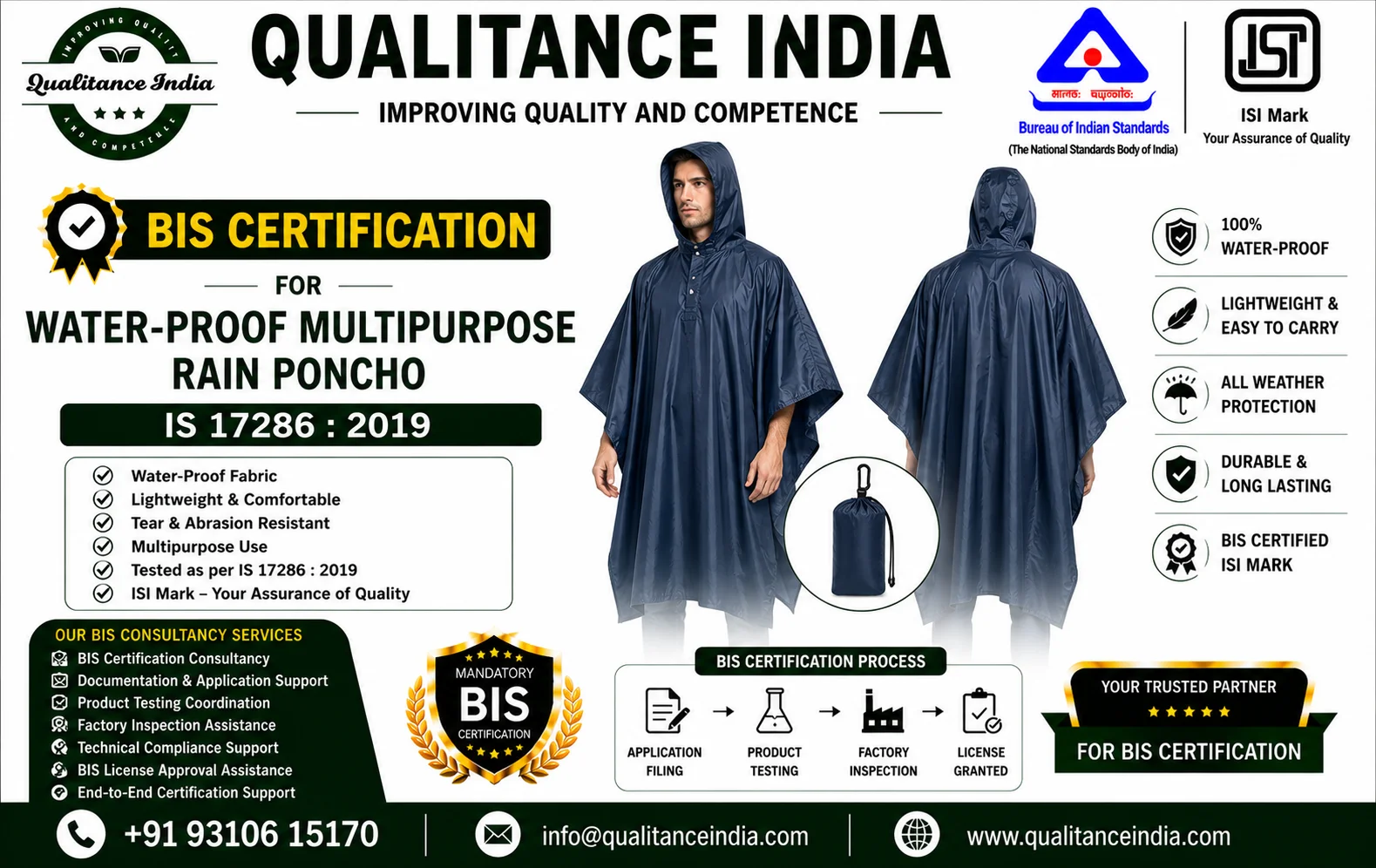
BIS Certification Consultancy for Water-Proof Multipurpose Rain Poncho | IS 17286:2019 | BIS & ISI Mark Certification
Introduction
A water-proof multipurpose rain poncho is designed to protect the wearer from rain while also providing additional utility through its ability to be converted into a bivouac or temporary protective shelter. This makes the product particularly relevant for outdoor activities, defence-related applications, camping, trekking, tactical use and situations where protection from weather conditions is important.
In India, IS 17286:2019 – Textiles – Water-proof Multipurpose Rain Poncho with Convertibility as Bivouac – Specification establishes requirements for this specialized textile product. The standard covers the general clothing design, material performance and test methods used to evaluate characteristics such as water resistance, strength, flexibility, colour fastness, moisture vapour transmission and convertibility.
The current BIS Product Manual PM/IS 17286/1 dated June 2025 operates certification under Scheme-I of the BIS Conformity Assessment Regulations, 2018. It specifies the product title, sampling requirements, testing equipment, Quality Assurance Plan, inspection controls, marking requirements and provisions for large manufacturers and MSME manufacturers.
IS 17286:2019 is also included in the BIS compulsory certification framework under the Protective Textiles (Quality Control) Order, 2022. The Ministry of Textiles subsequently amended the commencement provision and specified 7 October 2023 as the effective date. The QCO applies to the listed products but does not apply to goods meant for export. BIS's current Scheme-I listing continues to include IS 17286:2019 under Protective Textiles.
A further important development is that BIS announced an All India First Licence for “Textiles — Water Proof Multipurpose Rain Poncho with Convertibility as Bivouac” as per IS 17286:2019 on 30 September 2025.
Qualitance India provides end-to-end BIS Certification Consultancy for Water-Proof Multipurpose Rain Poncho as per IS 17286:2019, including product applicability review, documentation, sample preparation, laboratory testing coordination, BIS application support, factory inspection preparation, Quality Assurance Plan support and licence assistance.
What is IS 17286:2019?
IS 17286:2019 is titled:
“Textiles – Water-Proof Multipurpose Rain Poncho with Convertibility as Bivouac – Specification.”
The standard is specifically intended for water-proof multipurpose rain ponchos that can also be converted into a bivouac. BIS describes the product as a versatile rain-protection garment that can function as a temporary camp or shelter without a tent or other cover.
The standard addresses both the design of the garment and the performance of the materials used in its construction.
Important areas include:
- Material and manufacture
- Stitching
- Freedom from defects
- PU-coated fabric
- Cord
- Wide polyamide tape
- Sewing thread
- Eyelets
- Snap fasteners
- Slide fasteners
- Hook and loop fasteners
- Dimensions
- Strength
- Tear resistance
- Colour fastness
- Water resistance
- Flexibility
- Moisture vapour transmission
- PU film adhesion/separation
- Convertibility into bivouac
The current BIS Product Manual records no amendments against IS 17286:2019 in its June 2025 product-specific certification document and states that grouping guidelines are not applicable (NA).
What is a Water-Proof Multipurpose Rain Poncho?
A water-proof multipurpose rain poncho is a protective textile garment designed to cover the upper body and provide protection from rainfall and wet weather.
Unlike an ordinary raincoat, the product covered by IS 17286:2019 has an additional functional feature: it can be converted into a bivouac, allowing it to serve as a temporary shelter or protective covering.
BIS technical information identifies the main functional considerations as:
- Water resistance
- Material strength
- Flexibility
- Comfort
- Convertibility
- Durability
Polyamide materials, including nylon 6 or nylon 66, are referenced in BIS technical information because of characteristics such as tensile strength, scrub resistance and elasticity.
Applications of Water-Proof Multipurpose Rain Poncho
A product conforming to IS 17286:2019 can be relevant to applications such as:
- Outdoor rain protection
- Camping
- Trekking
- Mountaineering
- Defence applications
- Tactical applications
- Field operations
- Emergency outdoor use
- Adventure equipment
- Institutional and government procurement
- Weather-protection equipment
The standard's bivouac convertibility makes the product particularly useful where both personal rain protection and temporary shelter capability are required.
Scope of IS 17286:2019
The current BIS Product Manual defines the licence product name as:
Textiles – Water Proof Multipurpose Rain Poncho with Convertibility as Bivouac.
The certification scope should be established against the actual product design and the requirements of the standard.
Before laboratory testing, manufacturers should review:
- Poncho construction
- Pouch configuration
- PU-coated fabric
- Cord
- Polyamide tape
- Sewing thread
- Eyelets
- Snap fasteners
- Zippers
- Hook and loop fasteners
- Stitching arrangement
- Convertibility arrangement
- Product dimensions
- Material specifications
The current Product Manual states that grouping guidelines are NA, so manufacturers should not assume that different products or materially different constructions can automatically be covered under one tested configuration. The intended licence scope should be discussed and finalised before sample submission.
Is BIS Certification Mandatory for Water-Proof Multipurpose Rain Poncho?
Yes, for products covered by the applicable QCO.
IS 17286:2019 is included in the Protective Textiles (Quality Control) Order, 2022, which requires the specified goods to conform to the relevant Indian Standard and bear the Standard Mark under a BIS licence in accordance with Scheme-I. The QCO specifically excludes goods meant for export.
The commencement of the QCO was subsequently specified as 7 October 2023 by the amendment order published on 24 May 2023.
BIS's current Scheme-I page continues to list IS 17286:2019 – Water-proof multipurpose rain poncho under the Protective Textiles category.
Therefore, manufacturers supplying covered rain ponchos in the Indian market should assess their BIS licensing requirement before manufacture, sale or supply.
Protective Textiles Quality Control Order
The Protective Textiles (Quality Control) Order, 2022 was notified by the Ministry of Textiles and covers specified protective textile products, including water-proof multipurpose rain poncho.
The current BIS listing associates IS 17286:2019 with:
Protective Textiles (Quality Control) Order, 2022
along with:
- Protective Textiles (Quality Control) Amendment Order, 2022
- Protective Textiles (Quality Control) Amendment Order, 2024
The 2024 amendment omitted Schedule Serial No. 2 and the entries relating to that serial number. It did not remove the current BIS listing for IS 17286:2019 from the Protective Textiles certification page.
Manufacturers should always check the latest QCO notifications, exemptions and BIS certification position applicable to their product and business model.
Important BIS Update for IS 17286:2019
BIS issued an All India First Licence notice on 30 September 2025 for the product:
Textiles — Water Proof Multipurpose Rain Poncho with Convertibility as Bivouac
as per IS 17286:2019.
The first licence was issued by the Ghaziabad Branch Office to M/s Santram Kundanlal. The licence number shown in the BIS announcement was 8700208715.
This is useful evidence that BIS certification activity for this product category is operational and that manufacturers can actively pursue certification under the applicable framework.
Who Needs BIS Certification for Rain Poncho?
The requirement is relevant to manufacturers producing rain ponchos falling within the scope of IS 17286:2019.
Potentially affected businesses include:
- Rain Poncho Manufacturers
- Waterproof Garment Manufacturers
- Protective Textile Manufacturers
- Outdoor Equipment Manufacturers
- Camping Equipment Manufacturers
- Trekking Gear Manufacturers
- Tactical Equipment Manufacturers
- Defence Supply Manufacturers
- Institutional Textile Suppliers
- Government Procurement Suppliers
- OEM Manufacturers
- Contract Manufacturers
Importers, traders and other businesses dealing with covered goods should separately verify their legal obligations under the QCO and applicable BIS provisions.
BIS Certification Eligibility Requirements
A manufacturer applying for BIS certification should have suitable production and quality-control arrangements for the complete product.
Depending on the production model, important arrangements may include:
- Fabric cutting facility
- Sewing machines
- Stitching and finishing facilities
- Eyelet installation equipment
- Snap-fastener fitting equipment
- Zipper installation arrangements
- Hook and loop attachment facilities
- Cord fitting arrangements
- PU-coated fabric handling facilities
- Quality inspection tables
- Measuring equipment
- Fabric testing facilities
- Conditioning facilities
- Laboratory or access to permitted testing facilities
- Calibration arrangements
- Trained quality personnel
- Production records
- Test records
- Material traceability
- Packing and marking arrangements
The actual facility requirements depend on the manufacturing setup and the tests identified as routine under the applicable Quality Assurance Plan.
BIS Certification Process for Water-Proof Rain Poncho
Step 1 – Product Applicability Review
The product is reviewed against IS 17286:2019.
The review includes:
- Product design
- Water-proof construction
- Bivouac convertibility
- PU-coated fabric
- Pouch
- Accessories
- Stitching
- Material specifications
- Product dimensions
Step 2 – Standard Requirement Review
The manufacturer's product is compared against the applicable technical requirements and test methods specified under IS 17286:2019.
Step 3 – Product Scope Finalisation
The exact configuration proposed for the BIS licence is finalised.
This step should be completed before laboratory testing because grouping is shown as NA in the current Product Manual.
Step 4 – Raw Material and Component Review
The manufacturer verifies the conformity of specified materials and components.
Step 5 – Sample Preparation
The current BIS Product Manual specifies:
2 complete sets of Poncho with Pouch
along with:
| Sample / Component | Quantity |
|---|---|
| Poncho with Pouch | 2 complete sets |
| Cord | 2 metres |
| Polyamide sewing thread | 5–6 metres |
| Polyamide tape | 2 metres |
| Eyelets | 6 pieces each set |
| Snap fasteners | 6 pieces |
| Slide fasteners / zippers | 6 pieces each |
| Hook & loop fasteners | 5 metres |
The Product Manual states that this sample quantity applies for grant of licence, change in scope and factory surveillance, while market-surveillance sampling may depend on actual sample availability.
Step 6 – Laboratory Testing
The samples are tested against the applicable requirements of IS 17286:2019.
Step 7 – BIS Application
The manufacturer submits the BIS application and required technical and factory documents.
Step 8 – Factory Assessment
BIS assesses the manufacturing, inspection and testing arrangements.
Step 9 – Observation Closure
Any deficiencies or observations identified during the process are addressed with appropriate corrective evidence.
Step 10 – Licence Grant
After successful conformity assessment, BIS grants the licence for the approved product scope.
Step 11 – Standard Marking
The manufacturer applies the BIS Standard Mark to conforming products covered by the licence and follows the applicable marking requirements.
Testing Requirements for IS 17286:2019
Testing is a major component of BIS certification for rain ponchos because the product must perform under wet, mechanical and environmental conditions.
The current BIS Product Manual identifies a detailed testing programme.
Material and Manufacture
The product must comply with the relevant material and manufacturing provisions of IS 17286:2019.
The Product Manual requires manufacturers to maintain adequate in-process controls and records for material and manufacture.
Stitching
Stitching is an important quality characteristic because seams need to remain intact while the poncho is worn, folded, converted and exposed to water.
The current Product Manual identifies stitching as a routine requirement.
Freedom from Defects
Finished ponchos should be properly inspected for defects that could affect appearance, functionality, water protection or durability.
Nature of Fibre / Filament
The PU-coated fabric used for the poncho and pouch is evaluated for the nature of its fibre or filament.
The Product Manual references IS 667 for this characteristic.
Nature of Coating
The coating applied to the textile is checked because it is central to the water-proof performance of the fabric.
The current Product Manual identifies this as a control-unit test.
Width of Fabric
The width of the PU-coated fabric is an important dimensional parameter.
The test request specifically requires declaration of:
Width of PU-coated fabric.
Ends and Picks
Fabric construction is assessed through:
- Number of ends per decimetre
- Number of picks per decimetre
These characteristics influence the construction and strength of the fabric.
Mass of Fabric
The Product Manual identifies both:
- Mass of single-layer fabric
- Mass of de-proofed fabric
as applicable parameters.
Breaking Strength
The fabric is tested for breaking strength in:
- Warp direction
- Weft direction
The strip test uses a 5 × 20 cm fabric specimen between the grips, with the Product Manual referring to IS 7016 Part 2.
Tearing Strength
Tearing strength is evaluated in:
- Warp direction
- Weft direction
The current Product Manual identifies Method A-1 with reference to IS 7016 Part 3/1.
Colour Fastness to Washing
The material is checked for:
- Change in colour
- Staining on adjacent fabric
The current Product Manual refers to IS/ISO 105-C10.
Colour Fastness to Rubbing
Both:
- Dry rubbing
- Wet rubbing
are included in the testing framework.
The referenced method is IS/ISO 105-X12.
Colour Fastness to Light
Resistance to colour change under light exposure is tested according to the applicable method.
The Product Manual references IS/ISO 105-B02 and identifies this as a test that may be subcontracted at the specified frequency.
Dimensional Change Due to Relaxation
Dimensional change is evaluated in:
- Warp-wise direction
- Weft-wise direction
The Product Manual identifies IS 2977 for this test.
Accelerated Ageing
The fabric is evaluated after accelerated ageing at:
70°C ± 1°C for 168 hours
in a hot-air circulating oven.
This test is important for understanding the effect of elevated temperature on the material.
Low-Temperature Resistance
The material is tested at:
−30°C ± 2°C for 6 hours.
This helps assess the behaviour of the fabric under low-temperature conditions.
Resistance to Damage by Flexing
The current Product Manual specifies testing after:
100,000 cycles
using the applicable flexing methods.
The Product Manual identifies methods including:
- De-Mattia method
- Schildknecht method
- Crumple/flex method
depending on the applicable procedure.
Blocking
Blocking refers to unwanted adhesion or sticking between coated textile surfaces under specified conditions.
The Product Manual includes blocking as a routine test and identifies it for weekly control.
pH Value of Aqueous Extract
The pH of the aqueous extract is checked using the applicable cold method.
The Product Manual refers to IS 1390.
Water Repellency
Water repellency is assessed on the face side of the uncoated fabric through spray-rating testing.
The current Product Manual references IS 390.
Hydrostatic Pressure Head Test
This is one of the most important water-resistance tests.
The current Product Manual specifies:
60 cm water column for 60 minutes
on the face side of the uncoated fabric.
Bundesmann Shower Test
The Bundesmann shower test evaluates:
- Water absorption
- Water penetration
- Wetting of the inner surface
The Product Manual refers to IS 392 for this test.
Moisture Vapour Transmission
Moisture vapour transmission is important for wearer comfort because a protective garment should not only resist external rain but also allow suitable moisture-vapour transfer.
The current Product Manual references IS 16390.
Bending Length
Bending length is evaluated in:
- Warp-wise direction
- Weft-wise direction
The Product Manual references IS 6490.
PU Film Separation
The separation of the polyurethane film from the textile substrate is also tested.
This is important because separation of the coating can adversely affect water-proofing and service life.
The Product Manual identifies IS 17286 as the test method.
Requirements for Cord
The cord used in the poncho is separately controlled.
The Product Manual identifies tests covering:
- Nature of fibre/filament
- Length
- Mass per linear metre
- Breaking strength
- Colour fastness to washing
- Colour fastness to light
- Dimensional change due to relaxation
- pH value
Several of these requirements are checked for each cord consignment.
Requirements for Wide Polyamide Tape
The Product Manual specifies requirements for wide polyamide tape of 25 ± 1 mm.
The applicable checks include:
- Nature of fibre/filament
- Number of ends
- Number of picks per decimetre
- Width
- Mass per linear metre
- Colour fastness to washing
- Colour fastness to light
The Product Manual identifies control-unit testing for several of these properties.
Raw Material and Component Requirements
The current BIS Product Manual specifies that certain components must conform to requirements identified in the standard.
These include:
- Eyelets
- Snap fasteners
- Slide fasteners
- Polyamide sewing threads
- Hook and loop fasteners
The Product Manual allows conformity to be established through one or a combination of:
- Test report from a BIS-recognized or Government laboratory
- NABL-accredited laboratory report
- Material supplier's test certificate
- In-house factory test report
The Product Manual also states that these controls are relevant during grant of licence, change in scope and factory surveillance.
Important Raw Materials for Rain Poncho Manufacturing
A typical product may use:
PU-Coated Fabric
The primary textile material for the poncho and pouch.
Polyamide Sewing Thread
Used for assembly and stitching.
Cord
Used in the garment's fastening or adjustment arrangement.
Polyamide Tape
Used in specified construction areas.
Eyelets
Used where cord or attachment arrangements require reinforced openings.
Snap Fasteners
Used for closure and configuration.
Slide Fasteners / Zippers
Used where specified in the product construction.
Hook and Loop Fasteners
Used in the convertible arrangement and closure system.
Manufacturers should maintain complete traceability and conformity records for these materials and components.
Manufacturing Process for Water-Proof Rain Poncho
A typical manufacturing process may include:
- Receipt of PU-coated fabric
- Incoming material inspection
- Fabric identification and verification
- Fabric cutting
- Component cutting
- Pattern preparation
- Stitching
- Eyelet installation
- Snap-fastener installation
- Zipper installation
- Hook-and-loop attachment
- Cord fitting
- Polyamide tape attachment
- Pouch manufacturing
- Bivouac-conversion arrangement
- Dimensional inspection
- Visual inspection
- Water-resistance and material testing
- Final inspection
- Packing
- Marking
The exact production route depends on the manufacturer's design and machinery.
BIS Testing Equipment for IS 17286:2019
The current BIS Product Manual provides an indicative equipment list.
Depending on the manufacturer's proposed testing scope, facilities may include:
- Compound microscope
- Dissecting needles
- Fibre-identification equipment
- Digital weighing balance
- Hot plate
- Measuring table
- Steel scale
- Conditioning chamber
- Thread density counter
- Tensile testing machine
- Tearing-strength testing arrangement
- Launderometer
- Crockmeter
- Xenon arc/light tester
- Hot-air circulating oven
- Cold chamber
- Flex-testing machine
- Blocking-test equipment
- pH meter
- Spray-rating equipment
- Hydrostatic head tester
- Bundesmann shower apparatus
- Moisture vapour transmission tester
- Stiffness tester
- Vernier caliper
- Measuring tape
- Thickness gauge
- Inspection table
The BIS equipment list is described as indicative and for guidance only, so the final facility requirement should be determined against the applicable Product Manual and proposed licence scope.
BIS Factory Inspection for Rain Poncho
Factory assessment is an important stage of Scheme-I certification.
During factory inspection, BIS may review:
Fabric and Raw Material Storage
Proper identification, segregation and traceability of materials.
Cutting Section
Control over cutting patterns, dimensions and fabric identification.
Stitching Section
Sewing quality, seam construction and workmanship.
Accessory Assembly
Installation of eyelets, zippers, snap fasteners, hook and loop fasteners, tape and cord.
Pouch Manufacturing
Construction and compatibility of the pouch with the poncho.
Bivouac Convertibility
The conversion arrangement and functionality of the product.
Inspection Facility
Availability of appropriate measuring and inspection equipment.
Testing Laboratory
Routine testing facilities required by the Quality Assurance Plan.
Calibration
Calibration records for measuring and testing equipment.
Quality Records
Production and test records demonstrating conformity.
Packing and Marking
Correct Standard Marking and additional marking requirements.
Quality Assurance Plan and Continuing Compliance
The current BIS Product Manual requires the manufacturer to implement a Quality Assurance Plan covering regular testing and in-process controls.
The manufacturer must define:
- Control unit
- Test frequency
- Number of samples
- Applicable routine controls
- Recordkeeping arrangements
The recommended control unit is:
The entire quantity of Poncho + Pouch manufactured from the same consignment of raw material under similar conditions in a day.
The manufacturer must ensure conformity across production covered by the Quality Assurance Plan and maintain test records.
Routine Testing and Frequency
The current Product Manual provides guidance on frequency and whether tests are required in-house or may be subcontracted.
Important examples include:
| Requirement | Recommended Control |
|---|---|
| Nature of fibre/filament of fabric | Once a month or whenever raw material/supplier changes |
| Nature of coating | One sample per control unit |
| Fabric mass | One sample per control unit |
| De-proofed mass | One sample per control unit |
| Breaking strength | One sample per control unit |
| Tearing strength | One sample per control unit |
| Colour fastness to washing | One sample per control unit |
| Colour fastness to rubbing | One sample per control unit |
| Colour fastness to light | Once in 6 months or when raw material/supplier changes |
| Dimensional change due to relaxation | Once a week |
| Accelerated ageing | Once a month |
| Low-temperature resistance | Once a month |
| Flexing resistance | Once in three months or when raw material/supplier changes |
| Blocking | Once a week |
| pH | One sample per control unit |
| Water repellency | Once a week |
| Hydrostatic pressure | Once a month or when raw material/supplier changes |
| Bundesmann shower | Once a month or when raw material/supplier changes |
| Moisture vapour transmission | Once a week |
| Bending length | One sample per control unit |
| PU film separation | One sample per control unit |
These are the recommended levels of control in the June 2025 BIS Product Manual; the manufacturer must follow its submitted Quality Assurance Plan and ensure conformity to all applicable requirements.
In-House Laboratory and MSME Provisions
The BIS Product Manual distinguishes between routine testing and tests that can be subcontracted.
Tests identified as R require routine in-house capability under the standard provision, while tests identified as S may be subcontracted to a suitable laboratory.
Subcontracting is permitted to:
- BIS-recognized/empanelled laboratories, or
- Laboratories having valid NABL accreditation as per IS/ISO/IEC 17025.
For MSME manufacturers, maintaining a laboratory/in-house testing facility for routine tests marked “R” is optional under the Product Manual. MSMEs may use:
- Common cluster-based facilities
- Shared testing facilities
- BIS-recognized/empanelled laboratories
- NABL-accredited laboratories meeting the specified requirements
Large-scale manufacturers are expected to maintain an in-house laboratory equipped for routine tests, although the Product Manual also provides provisions for shared testing facilities in accordance with applicable BIS guidelines.
This provision can be especially useful for smaller textile manufacturers who may not have a full textile laboratory within their premises.
What is the BIS Sample Size for Rain Poncho?
For grant of licence, change in scope and factory surveillance, the current Product Manual specifies:
2 complete sets of Poncho with Pouch
along with the specified quantities of raw materials and components.
The sampling details are:
- 2 complete poncho + pouch sets
- Cord – 2 m
- Polyamide sewing thread – 5–6 m
- Polyamide tape – 2 m
- Eyelets – 6 pieces each set
- Snap fasteners – 6 pieces
- Slide fasteners – 6 pieces each
- Hook & loop fasteners – 5 m
Manufacturers should prepare the complete sample exactly according to the current Product Manual before sending it for testing.
Parameters to be Declared in Test Request
The current Product Manual specifically identifies:
Width of PU coated fabric
as a parameter to be declared in the test request.
Other applicable product details may also need to be declared depending on the standard and testing arrangement.
How Long Does Testing Take?
According to the current Product Manual, most tests can potentially be completed in one day where appropriately pre-conditioned samples are available.
However, the Product Manual specifically identifies tests that require additional time, including:
- Colour fastness to light
- Accelerated ageing at 70°C ± 1°C for 168 hours
- Flexing after 100,000 cycles
- Moisture vapour transmission
- Dimensional change due to relaxation in length-wise direction
Therefore, the actual laboratory timeline can be significantly longer than a single day when these tests are included.
Packing and Marking Requirements
Marking is an important part of BIS compliance.
The current Product Manual requires the Standard Mark to be incorporated legibly and indelibly on each poncho, provided the marked product conforms to all requirements of the specification.
The additional marking requirement specified by the Product Manual is:
“For BIS certification details please visit www.bis.gov.in”
Packing and marking must also comply with the Indian Standard and the conditions of the BIS licence.
Non-conforming products should not be marked with the Standard Mark, and their disposal must comply with applicable BIS requirements.
Documents Required for BIS Certification
A manufacturer should generally prepare documents such as:
- Company registration documents
- Factory address proof
- Factory layout
- Manufacturing process flow chart
- Machinery list
- Product drawings
- Product specifications
- Poncho design details
- Bivouac conversion details
- PU-coated fabric specification
- Raw-material details
- Supplier information
- Material test certificates
- Component test reports
- Sewing thread details
- Cord details
- Tape details
- Eyelet details
- Snap-fastener details
- Zipper details
- Hook and loop fastener details
- Testing equipment list
- Calibration certificates
- Quality Assurance Plan
- Internal inspection procedure
- Production records
- Test records
- Sample details
- Laboratory reports
- Product photographs
- Packaging details
- Marking details
- Authorised signatory documents
- Trademark documents, where applicable
The exact document list depends on the factory arrangement and proposed BIS scope.
Common Reasons for BIS Certification Delays
Manufacturers may face delays because of:
- Incorrect interpretation of IS 17286:2019
- Incomplete product specifications
- Incorrect PU-coated fabric
- Fabric construction non-conformity
- Low breaking strength
- Tearing-strength failure
- Poor colour fastness
- Excessive dimensional change
- Accelerated-ageing failure
- Low-temperature failure
- Flexing failure
- Blocking failure
- Incorrect pH
- Water-repellency failure
- Hydrostatic-pressure failure
- Bundesmann shower failure
- Moisture-vapour transmission failure
- PU film separation
- Incorrect cord specification
- Incorrect tape construction
- Poor stitching
- Incorrect zipper or fastener selection
- Missing material certificates
- Inadequate testing facilities
- Missing calibration records
- Incorrect sample quantity
- Factory not ready
- Incomplete QAP
- Poor production traceability
- Incorrect BIS marking
A technical review before testing can help identify many of these issues before the formal application is submitted.
BIS Certification Cost for Water-Proof Rain Poncho
There is no single fixed total BIS certification cost applicable to every manufacturer.
The overall expense may depend on:
- BIS application fees
- Laboratory testing
- Number of tests
- Laboratory location
- Sample preparation
- Factory assessment
- Testing equipment
- Calibration
- Documentation
- Retesting
- Product-development modifications
- Consultancy charges
Current BIS LIMS listings show significant variation between laboratories.
For example:
- One current laboratory listing shows ₹29,500 excluding taxes
- Another current listing shows ₹118,600 excluding taxes
- Another current listing shows ₹50,290 excluding taxes
These figures are laboratory-specific testing charges, not the complete BIS certification cost.
Because laboratory scope and charges can change, manufacturers should confirm the latest applicable laboratory quotation before testing.
BIS Certification Timeline for Rain Poncho
The total certification timeline depends on:
- Product readiness
- Standard compliance
- Sample preparation
- Laboratory availability
- Pre-conditioning requirements
- Testing duration
- Test results
- BIS application processing
- Factory readiness
- Inspection
- Observation closure
Long-duration tests such as 168-hour accelerated ageing and 100,000-cycle flexing can extend the laboratory stage.
A manufacturer can reduce avoidable delays by preparing the sample, documents, QAP, testing facilities and raw-material records before filing the application.
Benefits of BIS Certification for Water-Proof Rain Poncho
Regulatory Compliance
Helps manufacturers comply with applicable BIS and Protective Textiles QCO requirements.
ISI Mark
Eligible manufacturers can use the BIS Standard Mark on products covered by the approved licence.
Verified Water Protection
Hydrostatic pressure, water repellency and shower testing help evaluate the water-protection characteristics of the material.
Better Durability
Strength, tearing, ageing, low-temperature and flexing tests help evaluate material performance under demanding conditions.
Improved Product Quality
Routine inspection and testing promote consistent manufacturing.
Customer Confidence
Certification can strengthen buyer confidence in protective textile quality and conformity.
Institutional Market Acceptance
BIS compliance can be important for manufacturers participating in regulated or institutional procurement.
Better Traceability
Quality records and controlled raw-material systems support production traceability.
Why Choose Qualitance India?
Qualitance India provides professional BIS Certification Consultancy for manufacturers seeking BIS and ISI Mark certification.
For Water-Proof Multipurpose Rain Poncho as per IS 17286:2019, our consultancy support can include:
- Product applicability assessment
- IS 17286:2019 requirement review
- Product scope assessment
- Raw-material review
- Component conformity review
- Sample preparation guidance
- Laboratory testing coordination
- Test-parameter review
- BIS application assistance
- Factory inspection preparation
- Quality Assurance Plan support
- Testing facility guidance
- MSME testing-facility guidance
- Documentation preparation
- Calibration and recordkeeping guidance
- Observation closure support
- BIS licence assistance
Our objective is to help manufacturers move through the certification process in an organized manner, from initial product assessment and sample preparation to testing, BIS application, factory assessment and licence approval.
Contact Qualitance India
Phone: +91 93106 15170 Email: info@qualitanceindia.com Website: qualitanceindia.com
BIS Certification Process – Quick Flow
Product Identification ↓ IS 17286:2019 Requirement Review ↓ Poncho & Bivouac Design Assessment ↓ PU-Coated Fabric & Component Review ↓ Product Scope Finalisation ↓ Documentation Preparation ↓ Sample Preparation – 2 Complete Sets ↓ Laboratory Testing ↓ Test Report Review ↓ BIS Application ↓ Application Scrutiny ↓ Factory Assessment ↓ Observation Closure ↓ BIS Licence Grant ↓ Standard Mark on Approved Rain Ponchos
Frequently Asked Questions
1. What is IS 17286:2019?
IS 17286:2019 is the Indian Standard for Textiles – Water-proof Multipurpose Rain Poncho with Convertibility as Bivouac – Specification.
2. Is BIS certification mandatory for water-proof multipurpose rain poncho?
Products covered by IS 17286:2019 are included in the Protective Textiles QCO framework, which requires the covered goods to conform to the applicable Indian Standard and bear the Standard Mark under a BIS licence. Goods meant for export are excluded from the QCO.
3. Which BIS scheme applies to IS 17286:2019?
Certification is operated under Scheme-I of the BIS Conformity Assessment Regulations, 2018.
4. What is the sample quantity for BIS certification?
The current Product Manual specifies 2 complete sets of poncho with pouch, plus specified quantities of cord, sewing thread, polyamide tape, eyelets, snap fasteners, slide fasteners and hook-and-loop fasteners.
5. What is the control unit for rain poncho?
The recommended control unit is the entire quantity of Poncho + Pouch manufactured from the same consignment of raw material under similar conditions in a day.
6. Is product grouping available?
The current Product Manual states Grouping Guidelines: NA.
7. What fabric is used in a water-proof multipurpose rain poncho?
The standard uses PU-coated fabric, while BIS technical information identifies polyamide-based materials such as nylon 6 or nylon 66 among the materials used for this product category.
8. What are the main tests for rain poncho?
Important tests include fibre identification, coating, width, ends/picks, mass, de-proofed mass, breaking strength, tearing strength, colour fastness, dimensional change, accelerated ageing, low-temperature resistance, flexing, blocking, pH, water repellency, hydrostatic pressure, Bundesmann shower, moisture vapour transmission, bending length and PU-film separation.
9. What is the hydrostatic pressure test condition?
The Product Manual specifies a 60 cm water column for 60 minutes for the applicable hydrostatic pressure test.
10. What is the accelerated ageing condition?
Accelerated ageing is carried out at 70°C ± 1°C for 168 hours in a hot-air circulating oven.
11. What is the low-temperature test condition?
The Product Manual specifies −30°C ± 2°C for 6 hours.
12. How many flexing cycles are required?
The applicable flexing test evaluates resistance to damage after 100,000 cycles.
13. Is colour fastness tested?
Yes. Colour fastness to washing, rubbing and light are included in the testing programme.
14. Is the cord tested separately?
Yes. The Product Manual identifies separate requirements for cord including fibre nature, length, mass per linear metre, breaking strength, colour fastness, dimensional change and pH.
15. Is polyamide tape covered?
Yes. The Product Manual specifies requirements for wide polyamide tape of 25 ± 1 mm and identifies tests for fibre nature, ends, picks, width, mass and colour fastness.
16. Can raw-material conformity be established through supplier certificates?
Yes. The current Product Manual permits conformity to certain specified material requirements to be established through recognized laboratory reports, NABL-accredited laboratories, supplier test certificates or permitted in-house reports.
17. Do MSME manufacturers need a full in-house laboratory?
Not necessarily. For routine tests marked “R”, the Product Manual states that the in-house facility requirement is optional for MSMEs. They may use common cluster facilities, shared facilities, BIS-recognized/empanelled laboratories or suitable NABL-accredited laboratories.
18. Is factory testing important?
Yes. Several routine controls are intended to be performed at the manufacturer's facility, particularly for ongoing conformity and production control.
19. What marking is required on the poncho?
The Standard Mark must be incorporated legibly and indelibly on each conforming poncho covered by the BIS licence. The Product Manual also specifies additional marking stating that BIS certification details can be obtained from the BIS website.
20. What is the current BIS testing cost?
Current BIS LIMS listings show laboratory-specific charges including examples of ₹29,500, ₹50,290 and ₹118,600 excluding taxes, depending on the laboratory and scope. These are testing charges only.
21. Is the laboratory testing charge the complete BIS certification cost?
No. Application fees, factory assessment, equipment, calibration, documentation, retesting and consultancy expenses may be additional.
22. How long does BIS certification take?
The timeline depends on sample preparation, laboratory availability, test duration, documentation, BIS application processing, factory assessment and observation closure. Long-duration tests such as accelerated ageing and flexing can extend the testing period.
23. Has BIS already granted a licence for this product?
Yes. BIS announced an All India First Licence for Water Proof Multipurpose Rain Poncho with Convertibility as Bivouac as per IS 17286:2019 on 30 September 2025.
24. Can Qualitance India help with IS 17286:2019 certification?
Yes. Qualitance India provides product assessment, sample guidance, testing coordination, documentation assistance, BIS application support, factory inspection preparation and Quality Assurance Plan support.
People Also Ask
What is BIS certification for water-proof multipurpose rain poncho?
BIS certification is the conformity-assessment process through which a manufacturer demonstrates that its water-proof multipurpose rain poncho meets the applicable requirements of IS 17286:2019 and the relevant BIS certification framework.
Is IS 17286:2019 under a Quality Control Order?
Yes. IS 17286:2019 is included under the Protective Textiles (Quality Control) Order, 2022.
What is the BIS standard for waterproof rain poncho?
The applicable standard is IS 17286:2019 – Textiles – Water-proof Multipurpose Rain Poncho with Convertibility as Bivouac – Specification.
What is the sample requirement for IS 17286:2019?
The current BIS Product Manual requires 2 complete sets of poncho with pouch, along with specified accessory and raw-material samples.
What tests are performed on waterproof rain poncho?
The testing programme includes mechanical, textile, water-resistance, environmental and comfort-related characteristics such as breaking strength, tearing strength, water repellency, hydrostatic pressure, shower testing, moisture vapour transmission and flexing.
What is the hydrostatic pressure requirement?
The test is conducted using a 60 cm water column for 60 minutes according to the current Product Manual.
Is BIS certification required for imported rain poncho?
The applicability depends on the product and applicable regulatory framework. Importers should verify the QCO and BIS requirements before importing covered products into India.
Is BIS certification required if the rain poncho is manufactured only for export?
The Protective Textiles QCO states that the order does not apply to goods meant for export.
What is the role of the bivouac feature?
The product is specifically designed so that the rain poncho can be converted into a temporary bivouac or shelter, which is a defining functional aspect of the standard.
How do I obtain an ISI Mark for rain poncho?
A manufacturer needs to complete the applicable BIS certification process for IS 17286:2019, satisfy testing and factory requirements, obtain the BIS licence and then mark conforming products according to the licence conditions.
Frequently Searched Topics
- BIS Certification for Water-Proof Rain Poncho
- BIS Certification for Multipurpose Rain Poncho
- IS 17286:2019 Certification
- BIS Licence for Rain Poncho
- ISI Mark for Rain Poncho
- Rain Poncho BIS Certification in India
- Waterproof Poncho BIS Certification
- Protective Textiles BIS Certification
- IS 17286 Testing
- Rain Poncho Testing
- BIS Testing for Protective Textiles
- Protective Textiles QCO
- BIS Certification Consultancy
- BIS Consultant for Textile Products
- BIS Certification for Waterproof Textile Products
- BIS Certification for Defence Textile Products
- BIS Certification for Outdoor Protective Products
Related BIS Certification Services
- BIS Certification for Protective Clothing for Firefighters – IS 16890:2018
- BIS Certification for Protective Gloves for Firefighters – IS 16874:2018
- BIS Certification for Protective Clothing for Industrial Workers Exposed to Heat – IS 15748:2022
- BIS Certification for High Visibility Warning Clothes – IS 15809:2017
- BIS Certification for Protective Clothing for Welding and Allied Processes – IS 16655:2017
- BIS Certification for Other Protective Textile Products
- BIS Certification for Technical Textiles
- BIS & ISI Mark Certification
- BIS Laboratory Testing Coordination
- BIS Factory Inspection Assistance
- BIS Documentation Support
- BIS Quality Assurance Plan Support
Useful Website Links
Manufacturers reading this article may also find the following service topics relevant:
- BIS Certification Consultancy
- BIS Application Filing Support
- BIS Product Testing Coordination
- BIS Factory Inspection Assistance
- BIS Documentation Services
- BIS Licence Renewal Support
- BIS Scope Extension Assistance
- BIS Testing Equipment Guidance
- BIS Quality Control Documentation
These related topics can be linked to their respective service pages on the Qualitance India website to help visitors move from technical information to the relevant certification service.
For website banners or service images, suitable text can include:
BIS Certification for Water-Proof Multipurpose Rain Poncho
IS 17286:2019 | BIS Licence | ISI Mark
Water-Proof Rain Poncho BIS Certification Consultancy
Protective Textiles Certification – IS 17286:2019
Suggested descriptive text for website images:
- Water-Proof Multipurpose Rain Poncho with Bivouac Conversion
- IS 17286:2019 BIS Certification
- BIS & ISI Mark Consultancy for Protective Textiles
- Waterproof Rain Poncho Testing and Certification
- Protective Textile Product Certification in India
BIS Certification for Water-Proof Multipurpose Rain Poncho – IS 17286:2019
Manufacturing water-proof multipurpose rain poncho with convertibility as bivouac?
IS 17286:2019 covers important requirements for fabric quality, stitching, strength, water resistance, hydrostatic pressure, colour fastness, flexibility, moisture vapour transmission and other product characteristics.
The current BIS Product Manual specifies 2 complete poncho + pouch sets for sampling, along with specified raw-material and accessory samples.
Qualitance India provides complete consultancy support for BIS Certification, including documentation, sample preparation, testing coordination, BIS application, factory inspection preparation and Quality Assurance Plan support.
Contact Qualitance India 📞 +91 93106 15170 📧 info@qualitanceindia.com 🌐 qualitanceindia.com
Conclusion
Water-Proof Multipurpose Rain Poncho with Convertibility as Bivouac is a specialized protective textile product covered by IS 17286:2019. The standard is designed to establish requirements for the product's material, construction, water protection, durability, comfort and conversion capability.
The current BIS Product Manual PM/IS 17286/1 dated June 2025 operates certification under Scheme-I and specifies 2 complete sets of poncho with pouch as the primary sample requirement, together with specified quantities of cord, polyamide sewing thread, polyamide tape, eyelets, snap fasteners, zippers and hook-and-loop fasteners.
The technical testing programme is extensive. It includes fabric construction and strength, tearing, colour fastness, dimensional stability, accelerated ageing, low-temperature resistance, flexing, blocking, pH, water repellency, hydrostatic pressure, Bundesmann shower testing, moisture vapour transmission, bending length and PU-film separation.
The Product Manual also establishes a Quality Assurance Plan approach and recommends the control unit as the entire quantity of Poncho + Pouch produced from the same raw-material consignment under similar conditions in a day. MSME manufacturers receive flexibility regarding routine in-house testing facilities and can use common, shared or recognized laboratory arrangements according to the applicable provisions.
For marking, the current Product Manual requires the BIS Standard Mark to be applied legibly and indelibly on each conforming poncho covered by the licence, along with the specified additional BIS certification information.
The applicable Protective Textiles (Quality Control) Order framework makes conformity important for covered products supplied in India, while goods meant for export are excluded from the order.
Current BIS LIMS records demonstrate that testing is available through multiple laboratories, with charges varying significantly according to the laboratory and testing scope. Examples currently listed include ₹29,500, ₹50,290 and ₹118,600 excluding taxes. These figures represent laboratory testing charges and should not be considered the complete BIS certification cost.
BIS's announcement of an All India First Licence on 30 September 2025 further confirms active certification implementation for this product category.
For manufacturers, successful certification depends on proper preparation of the PU-coated fabric, accessories, stitching, product construction, sample set, testing facilities, quality records, Quality Assurance Plan, documentation and factory arrangements.
Qualitance India provides end-to-end BIS Certification Consultancy for Water-Proof Multipurpose Rain Poncho as per IS 17286:2019, covering product assessment, documentation, sample preparation, laboratory testing coordination, BIS application support, factory inspection preparation, Quality Assurance Plan assistance and licence support.
For BIS Certification and ISI Mark Consultancy for Water-Proof Multipurpose Rain Poncho, contact Qualitance India today.
Phone: +91 93106 15170 Email: info@qualitanceindia.com Website: qualitanceindia.com