
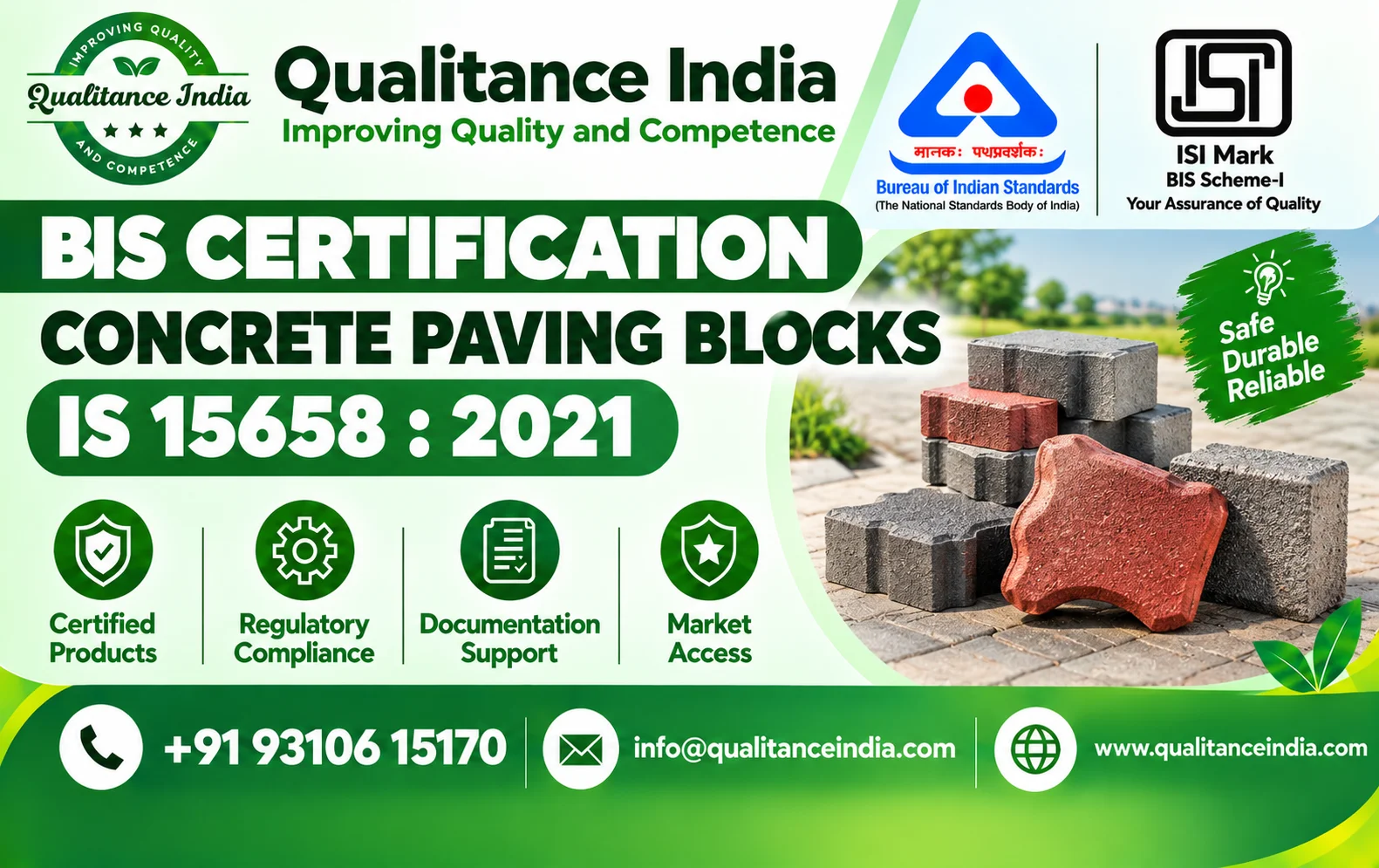
BIS Certification Consultancy for Concrete Paving Blocks | IS 15658:2021
Introduction
Concrete paving blocks, commonly known as paver blocks or interlocking concrete paver blocks, are widely used for footpaths, driveways, parking areas, roads, commercial premises, industrial yards and other paving applications.
Because paving blocks are exposed to loads, abrasion, moisture and environmental conditions, their strength, dimensions, water absorption and durability need to meet defined quality requirements.
The applicable Indian Standard is IS 15658:2021 – Concrete Paving Blocks – Specification (First Revision). BIS has issued a Product Manual for this standard under Scheme-I of the BIS (Conformity Assessment) Regulations, 2018. The Product Manual is specifically intended to guide BIS certification and prospective applicants seeking a BIS certification licence.
For manufacturers planning to manufacture or supply concrete paving blocks in India, understanding the BIS certification requirements, product grades, testing arrangements and quality-control system is essential.
What is IS 15658:2021?
IS 15658:2021 specifies requirements and test methods for concrete paving blocks used in paving applications.
The standard covers important characteristics such as:
- General quality
- Visual appearance
- Colour and texture
- Dimensions and tolerances
- Wearing-layer thickness
- Water absorption
- Compressive strength
- Abrasion resistance
- Tensile splitting strength
- Flexural strength/breaking load
- Freeze-thaw durability
The BIS Product Manual identifies M-30, M-35, M-40, M-50 and M-55 as the grade designations covered under the certification framework.
Is BIS Certification Mandatory for Concrete Paving Blocks?
Concrete paving blocks covered by the Concrete-Based Building Products (Quality Control) Order, 2023 are subject to conformity requirements under the applicable Indian Standard and are required to bear the Standard Mark under a BIS licence.
The QCO specifically identifies concrete paving blocks with reference to IS 15658:2021 and provides for certification under Scheme-I. It also does not apply to goods or articles meant for export.
Therefore, manufacturers supplying covered concrete paving blocks in the Indian market should obtain the applicable BIS licence before marketing products that fall within the QCO.
Manufacturers should always verify the latest government notification, amendments and applicability to their particular product before commercial production or supply.
BIS Certification Scheme for Paver Blocks
BIS certification for concrete paving blocks is operated under Scheme-I.
Under this certification route, BIS evaluates the manufacturer's:
- Manufacturing facilities
- Production process
- Quality-control arrangements
- Testing facilities
- Calibration system
- Product conformity
- Inspection and testing records
The BIS Product Manual for IS 15658:2021 specifically states that it is to be used for certification under Scheme-I.
After successful completion of the certification requirements, the manufacturer receives a BIS licence for the approved product scope and can use the BIS Standard Mark on conforming products according to the licence conditions.
Grades of Concrete Paving Blocks Under IS 15658:2021
IS 15658:2021 covers five principal grade designations:
M-30
M-30 is one of the specified concrete paving block grades under IS 15658:2021.
M-35
M-35 is another grade covered by the standard and BIS certification framework.
M-40
M-40 forms part of the first BIS grouping for certification.
M-50
M-50 is included in the higher-grade group of paving blocks.
M-55
M-55 is the highest grade identified in the BIS Product Manual.
Manufacturers should select and declare the grades they actually intend to manufacture and include in their BIS licence scope.
BIS Grouping Guidelines for Concrete Paving Blocks
The Product Manual divides the grades into two groups:
Group I: M-30, M-35 and M-40
Group II: M-50 and M-55
For Grant of Licence and Change in Scope of Licence, the Product Manual states that one sample from each group having the highest grade designation and any thickness is drawn and tested for all requirements in order to cover the applicable range of that group.
This grouping arrangement is important for manufacturers producing multiple grades because the certification scope is not simply determined by testing every individual grade separately.
The manufacturer must declare the varieties of paving blocks intended to be covered, and BIS may restrict the scope according to the manufacturer's manufacturing and testing capabilities.
Thickness and Dimensions of Paver Blocks
According to the BIS Product Manual, the thickness of concrete paving blocks is generally required to be:
- Not less than 50 mm
- Not more than 120 mm
Blocks having thickness greater than 120 mm may also be manufactured when agreed between the manufacturer and purchaser, subject to the applicable standard requirements.
The length and width are to be specified by the manufacturer.
Paving blocks can also be manufactured in:
- Single-layer construction
- Two-layer construction
These characteristics should be properly declared when establishing the BIS licence scope.
Raw Materials for Concrete Paving Blocks
Raw materials play an important role in maintaining consistent quality.
The BIS Product Manual identifies requirements relating to:
- Cement
- Mineral admixtures
- Chemical admixtures
- Coarse aggregates
- Fine aggregates
- Pigments
- Water
The Product Manual also specifies quality-control arrangements for these materials. For example, cement is required to be ISI marked and received with a test certificate under the specified inspection and testing arrangements.
Manufacturers should maintain appropriate incoming-material inspection and supplier/test-certificate records.
Manufacturing Process for Paver Blocks
A typical manufacturing process for concrete paving blocks may involve:
- Selection and inspection of raw materials
- Aggregate preparation
- Batching
- Mixing
- Addition of cement and admixtures
- Pigment addition where applicable
- Moulding or vibro-pressing
- Layer formation for double-layer blocks
- Compaction
- Demoulding
- Curing
- Inspection
- Testing
- Storage
- Dispatch
The actual manufacturing process may vary depending on the machinery and product design.
For BIS certification, the manufacturer should demonstrate that its process is capable of consistently producing paving blocks conforming to IS 15658:2021.
Important Tests for Concrete Paving Blocks
Testing is one of the most important parts of BIS certification.
General Quality
The blocks are examined for general quality according to the requirements of the standard.
Visual Inspection
Visual inspection is performed to check the appearance and conformity of the finished blocks.
Colour and Texture
Colour and texture are checked according to the applicable requirements.
Dimensions and Tolerances
Important dimensional characteristics include:
- Width
- Length
- Thickness
- Aspect ratio
- Arris/chamfer dimensions
- Other applicable dimensional parameters
The BIS Product Manual identifies suitable equipment such as steel rules, vernier calipers, gauges and engineers' squares for dimensional evaluation.
Thickness of Wearing Layer
For applicable multi-layer paving blocks, the thickness of the wearing layer is evaluated according to the standard.
Water Absorption
Water absorption is an important performance characteristic because paving blocks can be exposed to rain, water and moisture during service.
The BIS Product Manual specifies water-absorption testing as part of the inspection and testing framework.
Compressive Strength
Compressive strength is one of the key requirements for determining the performance of concrete paving blocks.
The BIS Product Manual specifies a compression testing machine with suitable bearing blocks and plates for this test.
Abrasion Resistance
Paving blocks are subjected to traffic and surface wear. Abrasion resistance therefore forms an important part of the performance evaluation.
The Product Manual identifies an abrasion testing machine and associated equipment for this test.
Tensile Splitting Strength
Tensile splitting strength is another mechanical property specified under IS 15658:2021.
Flexural Strength / Breaking Load
Flexural strength or breaking-load testing evaluates the block's performance under the specified loading conditions.
Freeze-Thaw Durability
Freeze-thaw durability is included in the standard's testing framework. The Product Manual states that this test may be carried out as required by the purchaser or once a year, whichever is earlier, under the Scheme of Inspection and Testing.
Sample Requirement for BIS Certification
The BIS Product Manual available for IS 15658:2021 specifies 50 blocks for all tests in its sampling section.
However, manufacturers should distinguish the overall sampling statement in the Product Manual from the specific sample quantities used for individual tests and from any subsequently revised Product Manual applicable at the time of application.
BIS requirements can be updated through revised Product Manuals, so the latest applicable document should always be checked before arranging samples.
Quality Control and Control Unit
Continuous quality control is essential after obtaining a BIS licence.
The Product Manual defines a control unit as every 25,000 precast concrete paving blocks or part thereof of the same size/shape and grade, manufactured under identical conditions from raw material of the same source in a week.
The manufacturer must maintain test records and conduct the specified tests at the prescribed frequency.
The Product Manual specifies, among other controls:
- General quality – each block
- Visual inspection – each control unit
- Colour and texture – each block
- Dimensions and tolerances – eight blocks from each control unit
- Wearing-layer thickness – eight blocks from each control unit
- Water absorption – three blocks once a month
- Compressive strength – four blocks once a month
- Abrasion resistance – six blocks once a month
- Tensile splitting strength – four blocks once in six months
- Flexural strength/breaking load – four blocks once in six months
- Freeze-thaw durability – three blocks as required by purchaser or once a year, whichever is earlier.
If a sample fails, the Product Manual provides for testing twice the number of samples from the same control unit for that requirement. If failure occurs again in the retest, the control unit is rejected.
Testing Facilities for Paver Block Manufacturers
A manufacturer seeking BIS certification needs suitable testing arrangements.
The Product Manual identifies equipment for:
- Aggregate testing
- Dimensional measurements
- Water absorption
- Compressive strength
- Abrasion resistance
- Tensile splitting strength
- Flexural strength/breaking load
- Freeze-thaw durability
The Product Manual also provides for permitted subcontracting of certain testing to laboratories recognized by BIS or government laboratories empanelled by BIS.
Therefore, manufacturers should assess their testing capabilities carefully before submitting the BIS application.
BIS Testing Cost for IS 15658:2021
Testing charges depend on the laboratory, grade, testing scope and individual test parameters.
Current BIS LIMS listings show several laboratories offering testing facilities for IS 15658:2021. Current examples include complete or substantially complete testing packages around:
- ₹12,500
- ₹14,900
- ₹15,000
- ₹15,800
- ₹17,000
- ₹20,000
- ₹25,000
excluding applicable taxes, depending on laboratory and scope.
Some laboratories separately list individual test charges or exclusions, while others provide a consolidated package.
Therefore, the actual testing cost should be confirmed from the selected BIS-recognized laboratory based on the exact product grade, scope and tests required.
BIS Inspection and Factory Assessment
BIS certification under Scheme-I involves assessment of the manufacturer's capability to produce conforming products.
During the factory assessment, attention may be given to:
- Manufacturing machinery
- Raw-material storage
- Mixing and batching arrangements
- Moulding/pressing machinery
- Curing arrangements
- Product storage
- Testing facilities
- Calibration records
- Quality-control personnel
- Production records
- Test records
- Product identification
- Marking arrangements
The manufacturer should have the factory operational and properly documented before the BIS assessment.
Documents Required for BIS Certification
Manufacturers should generally prepare documents such as:
- Company registration documents
- Factory registration details
- Factory address proof
- Factory layout
- Manufacturing process flow chart
- Machinery list
- Product specifications
- Details of grades to be covered
- Details of block sizes and thicknesses
- Raw-material specifications
- Cement test certificates
- Aggregate test reports
- Admixture details
- Pigment details, where applicable
- Water-source details
- Testing equipment list
- Calibration certificates
- Laboratory details
- Quality-control procedures
- Production records
- Test records
- Trademark/brand documents
- Authorized signatory documents
- Quality Assurance Plan
- BIS application documents
- Undertakings and declarations as applicable
The exact documentation should be finalized according to the latest BIS application requirements and the manufacturer's intended licence scope.
BIS Certification Process for Concrete Paving Blocks
Step 1: Identify the Correct Standard
Confirm that the product is a concrete paving block covered by IS 15658:2021.
Paving blocks should not be confused with concrete masonry blocks or other precast concrete products because different products may fall under different Indian Standards.
Step 2: Finalize the Product Scope
Determine:
- Grade
- Thickness
- Length and width
- Single-layer or double-layer construction
- Shape/design varieties
- Other applicable characteristics
Step 3: Factory Readiness Assessment
Review the production line, machinery, raw materials, laboratory/testing arrangements and quality-control system.
Step 4: Prepare Documentation
Prepare the required company, factory and technical documents.
Step 5: Arrange Product Testing
Arrange testing according to IS 15658:2021 through the applicable testing facility.
Step 6: Submit the BIS Application
Submit the BIS certification application through the applicable BIS online certification system.
Step 7: BIS Factory Assessment
BIS assesses the manufacturing facility and verifies the production and testing capabilities.
Step 8: Sample Testing and Compliance
Samples are evaluated against the applicable requirements of IS 15658:2021.
Step 9: Resolve BIS Observations
If BIS raises technical or documentary observations, the manufacturer needs to provide the required clarification and corrective action.
Step 10: Grant of BIS Licence
After successful completion of the applicable requirements, BIS may grant the licence for the approved product scope.
Step 11: Apply the Standard Mark
After receiving the licence, conforming production covered by the licence must be marked with the BIS Standard Mark according to the applicable marking requirements.
Step 12: Maintain Continuous Compliance
The manufacturer must continue testing, maintaining records and producing paving blocks according to the applicable BIS requirements.
BIS Certification for Foreign Paver Block Manufacturers
Foreign manufacturers supplying concrete paving blocks to India should also examine the applicable BIS certification requirements.
Eligible overseas manufacturers can apply through the BIS Foreign Manufacturers Certification Scheme (FMCS) where applicable.
For an overseas paver block manufacturer, the certification process may involve:
- Identification of IS 15658:2021 applicability
- Product scope assessment
- Factory documentation
- Testing arrangements
- Factory inspection
- Authorized Indian Representative
- BIS application
- Sample testing
- Compliance with BIS marking requirements
This is relevant for companies searching for BIS certification for foreign manufacturers, BIS licence for overseas paver block manufacturers, BIS certification for imported paver blocks, or BIS certification for paver blocks for export to India.
The QCO for concrete-based building products states that it does not apply to goods or articles meant for export.
BIS Certification for Imported Concrete Paving Blocks
Importers and foreign manufacturers should not assume that an imported paver block can automatically be sold in India without BIS compliance.
Where the product is covered by the applicable QCO, the manufacturer should establish the appropriate BIS certification route before commercial supply.
For foreign factories, BIS FMCS is the relevant route to examine where applicable. The certification is linked to the manufacturing facility and the applicable Indian Standard rather than simply to an Indian trader or distributor.
Why BIS Certification is Important for Paver Block Manufacturers
Concrete paving blocks are used in applications where mechanical performance and durability are important.
BIS certification helps establish conformity with the applicable Indian Standard and is particularly relevant for manufacturers supplying:
- Government projects
- Infrastructure projects
- Municipal projects
- Commercial developments
- Residential projects
- Industrial areas
- Roads and walkways
- Parking areas
- Construction companies
- Builders and contractors
- EPC companies
- Project developers
- Building-material distributors
A manufacturer should ensure that the actual product supplied corresponds to the approved BIS licence scope.
Common Problems in BIS Certification for Paver Blocks
Manufacturers can experience delays if the factory is not adequately prepared.
Common issues include:
- Selecting the wrong Indian Standard
- Incorrect grade declaration
- Incomplete product scope
- Inadequate testing equipment
- Missing calibration certificates
- Poor raw-material control
- Incomplete production records
- Missing test records
- Incorrect sampling
- Failure to maintain control-unit records
- Non-conforming compressive strength
- Excessive water absorption
- Abrasion resistance failures
- Dimensional non-conformity
- Incorrect BIS marking
- Inadequate factory preparation
A pre-certification assessment can help identify these issues before the formal BIS inspection.
How Qualitance India Can Help with BIS Certification for Paver Blocks
Qualitance India provides BIS certification consultancy services for manufacturers seeking BIS licences under applicable Indian Standards.
For Concrete Paving Blocks as per IS 15658:2021, our support can include:
- BIS applicability assessment
- IS 15658:2021 scope review
- Grade and product grouping guidance
- Documentation preparation
- BIS application support
- Laboratory testing coordination
- Test report coordination
- Factory readiness assessment
- Factory inspection preparation
- Testing equipment guidance
- Calibration documentation support
- Quality-control documentation
- BIS query response assistance
- Licence grant support
- Post-certification compliance guidance
- Support for eligible foreign manufacturers
Whether you are an Indian paver block manufacturer or an overseas manufacturer planning to supply concrete paving blocks to India, proper preparation can help make the BIS certification process more structured.
Frequently Asked Questions
1. What is the BIS standard for concrete paving blocks?
The applicable Indian Standard is IS 15658:2021 – Concrete Paving Blocks – Specification (First Revision).
2. Is BIS certification mandatory for concrete paving blocks?
Concrete paving blocks covered by the Concrete-Based Building Products QCO, 2023 are subject to BIS conformity requirements and Standard Mark provisions under Scheme-I.
3. Which BIS scheme applies to paver blocks?
BIS certification for IS 15658:2021 is operated under Scheme-I.
4. What grades are covered under IS 15658:2021?
The specified grades are M-30, M-35, M-40, M-50 and M-55.
5. What are the BIS grouping categories?
Group I consists of M-30, M-35 and M-40, while Group II consists of M-50 and M-55.
6. What thickness of paver blocks is covered?
The Product Manual states that block thickness is generally not less than 50 mm and not more than 120 mm, with blocks above 120 mm possible when agreed between manufacturer and purchaser.
7. Can paver blocks be single-layer or double-layer?
Yes. The BIS Product Manual recognizes both single-layer and two-layer construction.
8. How many blocks are specified in the Product Manual for all tests?
The Product Manual available for IS 15658:2021 specifies 50 blocks for all tests in its sampling section.
9. What tests are required for paver blocks?
Important tests include dimensions, water absorption, compressive strength, abrasion resistance, tensile splitting strength, flexural strength/breaking load and applicable freeze-thaw durability, along with visual and general quality requirements.
10. Is compressive strength testing required?
Yes. Compressive strength is one of the key performance requirements under IS 15658:2021.
11. Is abrasion resistance tested?
Yes. Abrasion resistance is included in the product testing and inspection framework.
12. Is freeze-thaw testing mandatory for every batch?
The Product Manual specifies freeze-thaw durability testing as required by the purchaser or once a year, whichever is earlier, under the stated inspection and testing scheme.
13. What is a control unit?
A control unit consists of every 25,000 paving blocks or part thereof of the same size/shape and grade, manufactured under identical conditions from raw material of the same source in a week.
14. Can testing be subcontracted?
The Product Manual permits specified testing to be subcontracted to laboratories recognized by BIS or government laboratories empanelled by BIS, subject to the applicable requirements.
15. What is the testing cost for IS 15658:2021?
Current BIS LIMS listings show laboratory packages ranging approximately from ₹12,500 to ₹25,000 or more depending on the laboratory and testing scope, excluding applicable taxes.
16. Does every paver block manufacturer need the same BIS licence scope?
No. The manufacturer declares the varieties intended to be covered, and BIS may restrict the licence scope according to the manufacturer's manufacturing and testing capabilities.
17. Can MSME paver block manufacturers apply for BIS certification?
Yes. Eligible MSME manufacturers can apply for BIS certification subject to the applicable BIS requirements and certification provisions.
18. Can foreign manufacturers obtain BIS certification for paver blocks?
Eligible foreign manufacturers can explore the BIS Foreign Manufacturers Certification Scheme for supplying products to the Indian market.
19. Does the QCO apply to paver blocks manufactured only for export?
The Concrete-Based Building Products QCO states that it does not apply to goods or articles meant for export.
20. Why should a paver block manufacturer take BIS consultancy support?
BIS certification involves product-scope selection, testing, documentation, factory preparation, quality control and ongoing compliance. Professional BIS consultancy can help coordinate these stages and reduce avoidable documentation and compliance issues.
Conclusion
Concrete Paving Blocks as per IS 15658:2021 are an important construction product used across residential, commercial, infrastructure and industrial paving applications.
The BIS certification framework under Scheme-I covers important requirements including grades, dimensions, water absorption, compressive strength, abrasion resistance, tensile splitting strength, flexural performance and durability. The Product Manual also establishes grouping guidelines, sampling, testing equipment and ongoing inspection and testing requirements.
For manufacturers supplying covered concrete paving blocks in India, compliance with the applicable Concrete-Based Building Products (Quality Control) Order, 2023 and obtaining the required BIS licence is an important part of market compliance.
Get BIS Certification Consultancy for Concrete Paving Blocks
Qualitance India provides end-to-end BIS certification consultancy support for manufacturers seeking BIS certification for concrete paving blocks under IS 15658:2021.
Our support can cover product scope assessment, documentation, laboratory testing coordination, BIS application, factory inspection preparation, compliance assistance and licence support.
Qualitance India Phone: +91-9310-615-170 Email: info@qualitanceindia.com Website: qualitanceindia.com
Contact Qualitance India for professional assistance with BIS Certification, ISI Mark Licence, product testing and BIS compliance for Concrete Paving Blocks as per IS 15658:2021.